Sibling Discounts in Children’s Activity Schools: Why Everyone Offers Them (and Why Most Handle Them by Hand)

“We give a sibling discount.” Why? “Because everyone does.” That’s not a strategy — it’s a reflex. And when you bolt a manual discount code onto that reflex, plus a receptionist who can’t remember which parent has two kids enrolled, you’ve got a problem you don’t even know about. Let’s look at why a sibling discount in a children’s activity business makes hard economic sense — and, more importantly, why you should never run it by hand.
A Sibling Discount Isn’t Generosity — It’s Pure Math
A family with two children in the same dance studio or language school isn’t twice the customer. They’re worth much more. Look at the numbers:
-
Acquisition cost is nearly identical. One parent, one conversation, one pickup. Whether they enrol one child or two, your marketing spent the same.
-
Lifetime value is 2×. You earn double from a single parent without spending a cent acquiring the second child.
-
Switching costs rise dramatically. A parent leaving has to move both kids — different schedules, different levels, a new club for each. That’s a logistical nightmare most families would rather avoid.
-
The sibling effect. The younger child wants to do what the older one does. You don’t have to sell them — their own brother or sister does it for you. Research confirms that sibling influence on consumer decisions is stronger inside families than most operators realise.
Add the psychology on top: a parent compares the price of the second child against what they already pay — not against the market average. Richard Thaler’s theory of mental accounting describes exactly how consumers evaluate bundled and separate costs. A 10% discount on the second child reads as “this is fair” to the parent — and to you, it’s an investment that pays back many times over.
Why Everyone Offers It: Not Altruism, Equilibrium
If your competitor — the gymnastics club across the street, or the STEM academy one neighbourhood over — offers a sibling discount and you don’t, you lose the second child. And often the first too, because the parent consolidates around the simpler option.
In game theory this is a Nash equilibrium: every player in the market has converged on the same strategy because deviating gets punished. So the question isn’t whether to offer a sibling discount. The question is whether you run it strategically and systematically — or reactively and chaotically.
According to Bain & Company’s analysis, a 5% increase in retention can lift profit by 25–95%. A two-child family that stays one season longer is exactly that kind of retention gain — amplified.
The Manual Discount: A Problem You Can’t See
Challenge: Most schools handle sibling discounts by hand — a discount code, a note in a spreadsheet, or a verbal arrangement at reception. That creates a chain of hidden failures: codes expire or get shared, receptionists forget, the discount gets applied inconsistently across locations, and you have zero data on how many families actually use it.
The worst case? A parent assumes the discount applies automatically. They don’t repeat the request. They pay full price. Two months later they hear from another parent that the discount exists. They feel cheated — and they leave. With both children.
This isn’t hypothetical. If you run multiple locations or a franchise, you multiply the problem by the number of sites. At one location the discount works, at the next nobody knows about it, at the third it only applies when the parent asks. That isn’t a system — it’s roulette.
What the Automatic Sibling Discount Looks Like in Zooza
Zooza identifies siblings by the parent’s email address. When a parent enrols a second child, the discount applies automatically at checkout. No code. No awkward conversation at reception. No “sorry, I forgot to add it.”
Configurable discount tiers:
- 10% for the 2nd child
- 15% for the 3rd child
- 20% for the 4th and each additional child
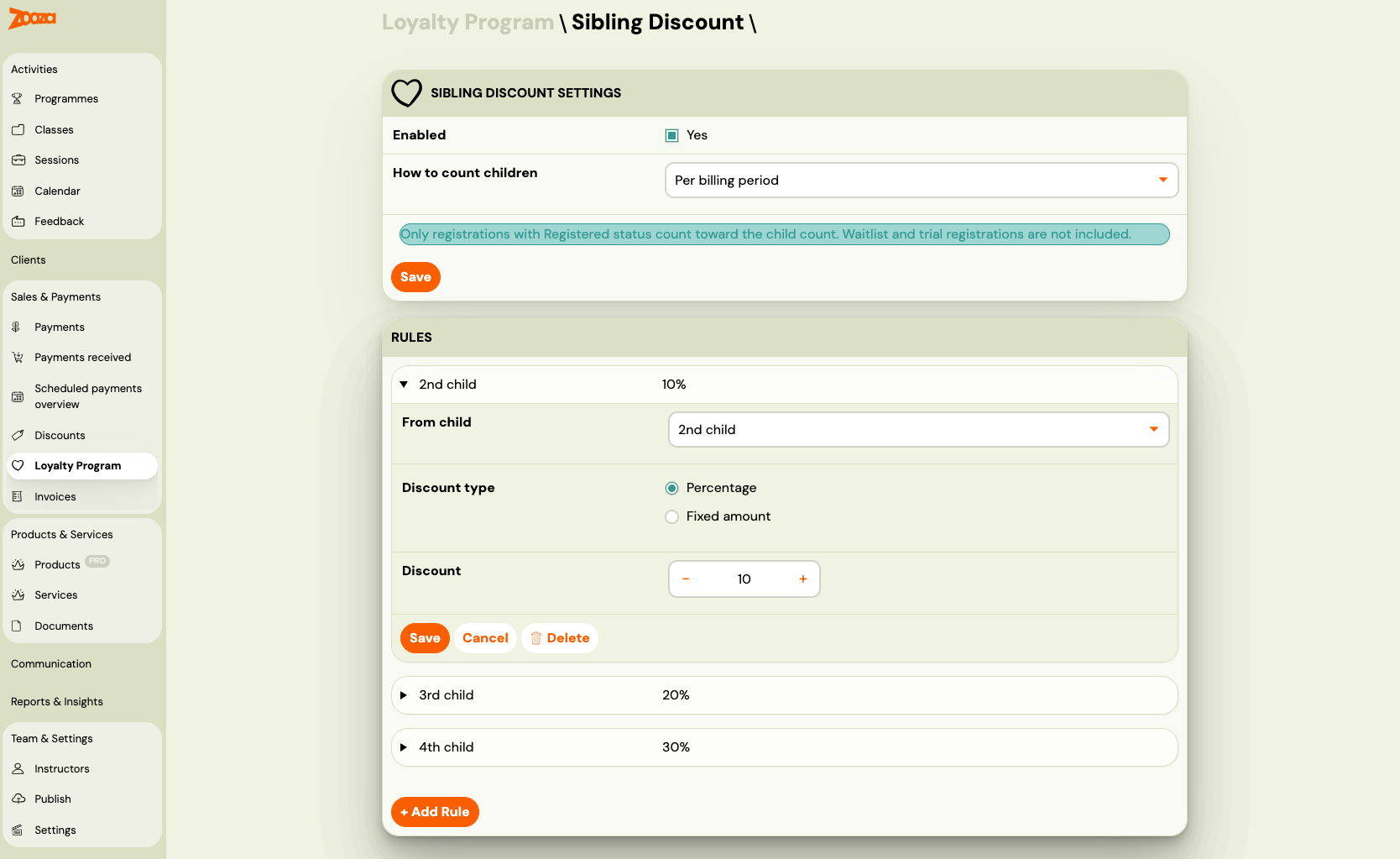
It works across every payment type — one-off, instalments, memberships, and per-session billing. You set the counting scope yourself: the discount can apply within a billing period, to a specific course, or across all your activities. This matters most for schools with a broad catalogue — if your STEM academy runs robotics and coding in parallel, you decide whether the discount counts per course or across the board.
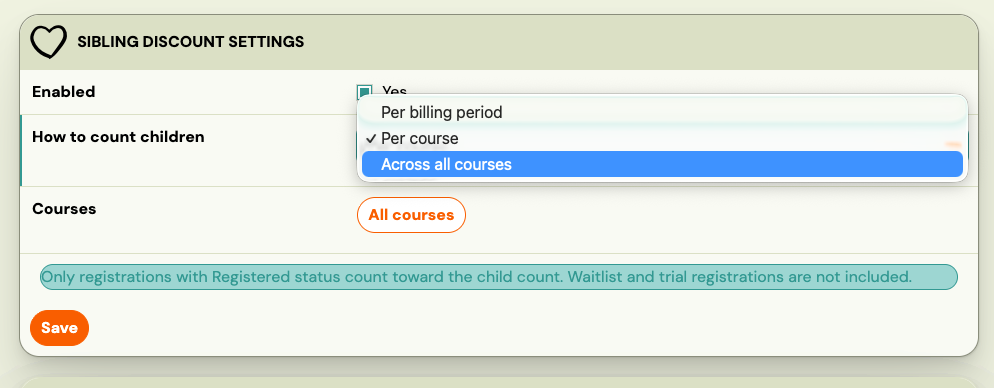
Solution: In Zooza you set up the sibling discount once — and the system applies it automatically on every registration. Consistently. At every location. With a full data trail of how many families actually use it.
The Retention Argument: Why That Small Moment at Checkout Decides
When a parent enrolling a second child sees the discount applied automatically at checkout, something important happens: they feel recognised. That moment — “the system knows I have two kids here” — is a small but real signal of loyalty. The parent didn’t have to ask, explain, or hunt for anything.
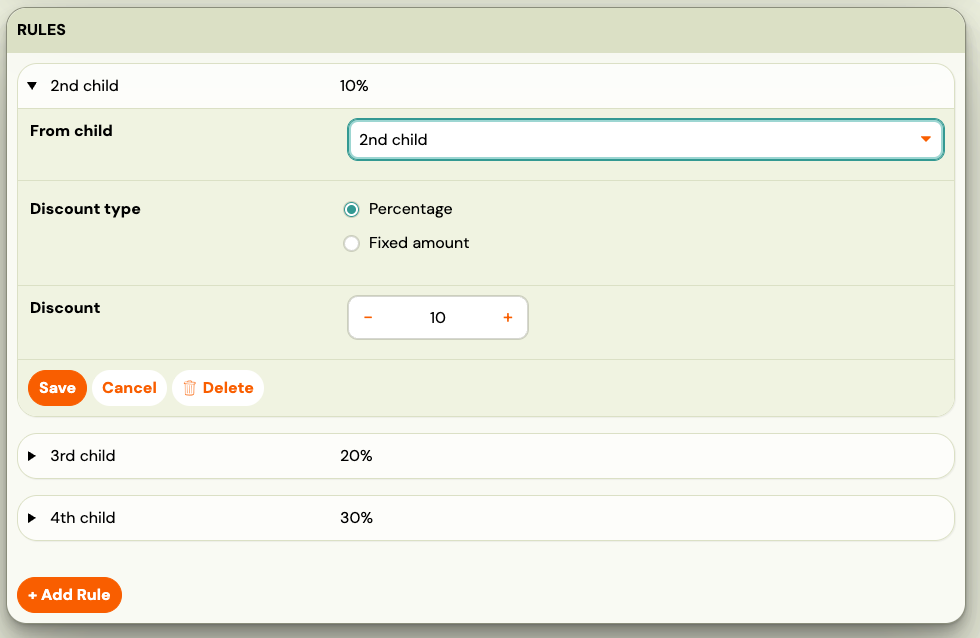
That removes the hesitation at the second enrolment. The parent doesn’t need to calculate whether it’s worth it or compare against a competitor. They see a fair offer, automatically, and click “enrol.”
The sibling discount is just one part of the broader loyalty program in Zooza. You can stack it with referral rewards — when an existing parent recommends your school to another family — to turn isolated concessions into a system. For the full picture of how the layers fit together, read why your loyalty program is really about three moments.
One Step You Can Take Today
If you have a sibling discount but you’re running it by hand — change that. Not tomorrow, not next term. A single setting in Zooza replaces dozens of manual operations and eliminates the risk of losing a family over a discount someone forgot to mention.
Start here: the sibling discount setup guide. Or see everything Zooza does if you want the whole picture.