You Launched a Referral Program — How Do You Know If It Actually Works?

Most operators of children’s activities and courses do the right thing: they launch a referral program. And then they wait. The problem? Without concrete numbers you can’t tell whether the program is working slowly or not working at all. Referral program metrics in a children’s activity business are the key to knowing what’s in front of you — patient waiting, or an urgent fix.
If you haven’t launched a referral program yet, start with our guide on why and how to set one up. This article is for the ones who already have it running — and want to know whether it’s actually earning.
The Four Metrics That Actually Matter
You don’t need to track twenty charts. Four numbers tell you everything that counts.
-
Referral Rate. What percentage of your active clients referred at least one new family. A healthy benchmark for children’s activities: 15–25%. If you’re below 10%, something is broken.
-
Referred-Lead Conversion Rate. Referred prospects convert 3–5× better than cold traffic from ads, according to Nielsen’s research. If that’s not happening for you, the problem is in the offer to the new client.
-
Time to First Referral. Most referrals arrive in months 2 to 4 of the client relationship — not the first. A parent has to see their child’s results before they recommend you onward.
-
LTV Ratio: Referred vs. Non-Referred Clients. Research from the Wharton School shows referred clients carry 16–25% higher lifetime value. They stay longer, pay more reliably, and refer others.
A Real-World Example: How It Looks at “Nova Dance”
Picture a studio with 120 active students. They launch a referral program with a reward: for every new student who enrols and pays, the referrer gets €10 off their next month. The new student gets their first lesson free.
Here’s a realistic trajectory over the first 90 days:
Challenge: For the first 30 days nothing dramatic happens. The owner feels the program isn’t working and considers killing it. But this is completely normal — referrals need time to gather momentum.
Nova Dance — referral program at 30 / 60 / 90 days
-
Referral Rate: 30 days → 4% | 60 days → 11% | 90 days → 19% | Acceleration kicks in once the first referrers receive their reward and tell other parents.
-
Referred leads: 30 days → 6 | 60 days → 18 | 90 days → 34 | Geometric growth — every happy parent starts a chain.
-
Referred-lead conversion: 30 days → 50% | 60 days → 61% | 90 days → 65% | Far better than paid ads (typically 8–15%).
-
New students enrolled via referral: 30 days → 3 | 60 days → 11 | 90 days → 22 | By day 90, nearly one in five new students comes from a referral.
The turning point came in week 6, when the first five parents received their discount. They shared it in the class WhatsApp group — and over the next two weeks, 9 new referrals came in. According to Bain & Company, businesses with high NPS grow 2.5× faster through referral. In children’s activities it’s doubly true — parent communities are strong.
Three Diagnoses When a Referral Program Isn’t Working
If you’re still under 5% referral rate after 60 days, the problem is almost always one of three things.
1. Clients Don’t Know the Program Exists
The most common failure. You set up the program, but parents don’t know about it. No reminder, no visible link. According to Harvard Business Review, client satisfaction is a necessary condition for a referral — but it isn’t sufficient. You have to actively nudge the client.
Solution: An automatic reminder after the 3rd payment. By that point the parent has seen the child’s progress and is willing to recommend.
2. The Reward Is Too Far Away
Did you set the threshold at 3 referrals before any reward pays out? Most parents give up after the first. Nobody wants to collect points for half a year.
Solution: Lower the first milestone. Reward the first successful referral. An immediate sense of winning motivates the next one.
3. The Referred Friends Don’t Enrol
Your clients refer, but the new prospects don’t convert. The problem isn’t the referrer — it’s the offer to the new client.
Solution: A two-sided reward. The referrer gets a discount, but the new client also has to receive something tangible — a free first lesson, a discount on the first month, or a gift for the child. The referral has to be worth it for both sides.
What “Working” Means After Six Months
After half a year, you should see three clear signals:
- Referral rate ≥ 18% — nearly one in five clients has actively referred
- Referred-client LTV ≥ other clients’ LTV — ideally 15–20% higher
- At least 1 in 5 new enrolments is traceably from a referral
If you’re hitting these numbers, your referral program is your cheapest and most effective acquisition channel. If not — go back to the three diagnoses above.
How Zooza Shows You All of This Automatically
Tracking referral program metrics in a children’s activity business by hand — in a spreadsheet or in your head — is unreliable and unsustainable. Zooza solves it by making every step automatically recorded and visible.
Activity Log — every referral event is timestamped. You know exactly when someone referred, when the new prospect registered, when they paid. No guessing. Details are in the Activity Log documentation.
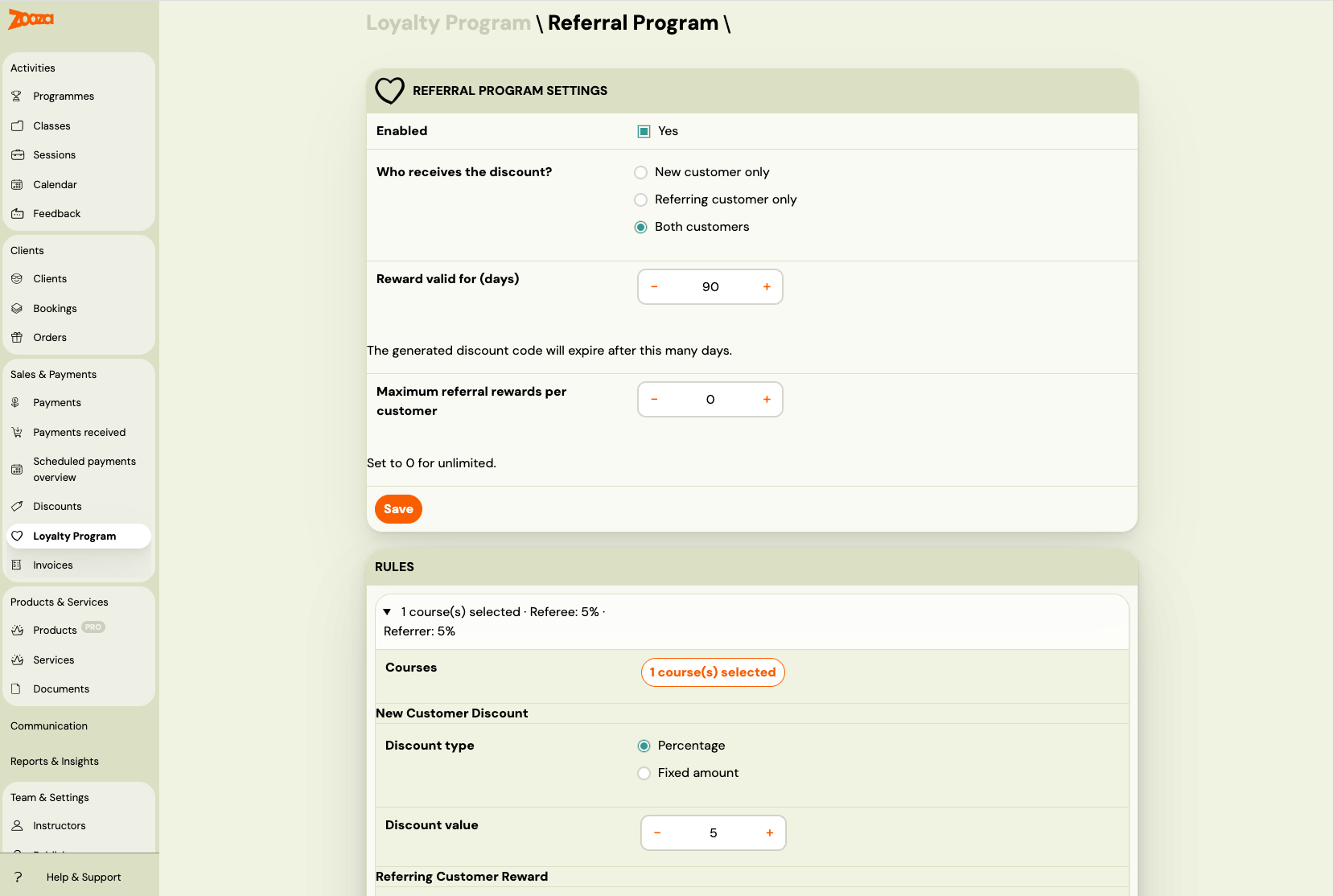
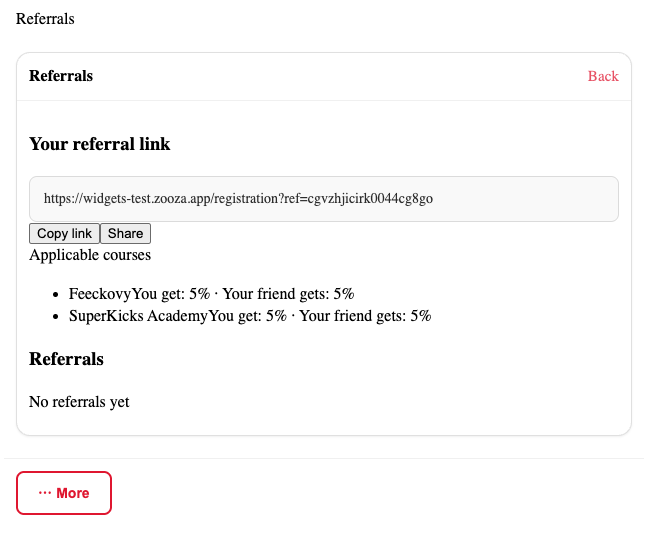
Client view — the parent sees their own referral link right inside the booking system. Nothing to hunt for; they just share.
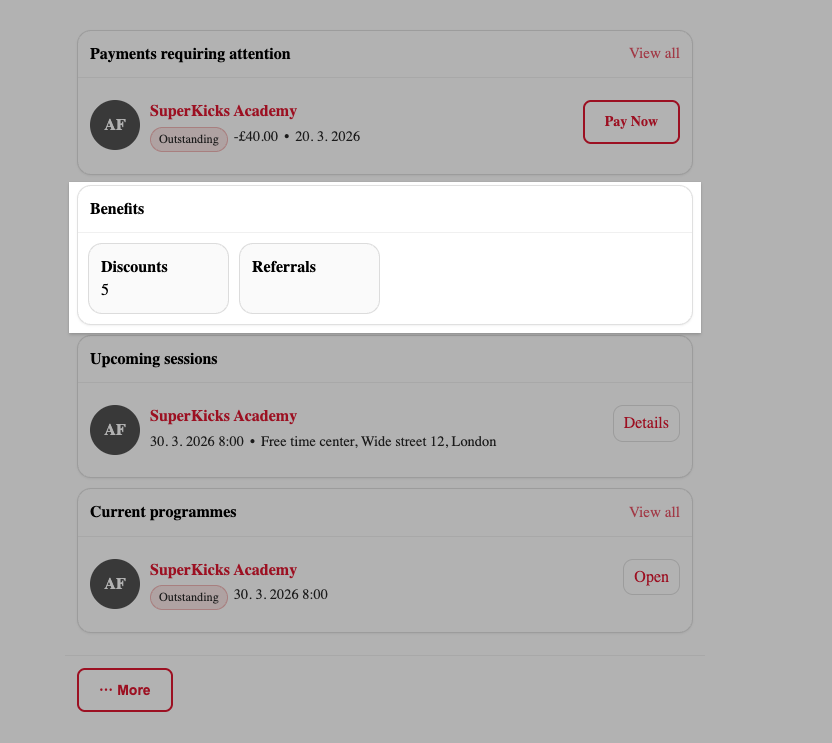
And more importantly — the parent sees how many referrals they’ve already made and how close they are to a reward. That transparency is the main driver of engagement. Details in the Client View documentation.
The whole loyalty program in Zooza — from setting the reward threshold to automatic notifications — is designed so you don’t have to become an analyst. The numbers are there. You just have to look. The referral layer is one of three; see how it fits with sibling discounts and returning-client pricing in why your loyalty program is really about three moments.
One Step You Take Today
Open your referral program and find one number: what percentage of your active clients has referred at least one person. If you can’t find that number in 30 seconds, you have a tools problem, not a program problem. If you can find it and it’s under 10% after more than 60 days — work through the three diagnoses above and fix the first one that fits.
And if you haven’t set up a referral program yet? Start here — the complete setup guide.